On 22 July 2028, a total solar eclipse will sweep across Australia, travelling through Western Australia, the Northern Territory, Queensland and New South Wales before crossing Sydney.
For a few extraordinary minutes, the Moon will completely cover the Sun. Daylight will fade, temperatures may drop and the Sun’s magnificent corona will become visible. It’s an experience that people travel around the world to witness and for communities in the path of totality, it presents an extraordinary opportunity.
But here’s the thing: the eclipse may last just a few minutes. The benefits to your community could last for years.
The world is already preparing
With less than two years to go, planning is gathering momentum. Accommodation providers are receiving bookings, tour operators are developing itineraries, and transport suppliers are preparing for increased demand. For councils and regional tourism organisations, this is the time to start considering what the eclipse could mean for their communities.
Will visitors simply arrive, watch the eclipse and leave? Or could this be an opportunity to introduce them to everything that makes your destination special?
More than an astronomical event
A total solar eclipse is a remarkable natural spectacle, but its potential extends well beyond astronomy. For regional communities, particularly those across outback Australia, it offers a rare opportunity to attract new visitors, showcase local businesses and develop experiences that encourage people to stay longer. Think nature-based tourism, Aboriginal cultural experiences developed with Traditional Owners, local food, heritage, wildlife, stargazing and community celebrations.
For destinations with naturally dark skies, there’s an especially exciting connection between the eclipse and astronomy tourism. Visitors may come to see the Sun disappear, but they could leave with a new appreciation for the stars.
A little preparation goes a long way
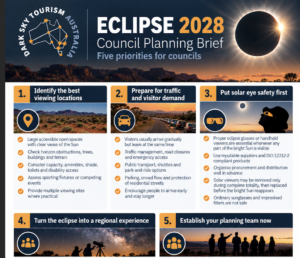
We’ve developed a practical 2028 Total Solar Eclipse Planning Flyer to help councils and tourism organisations begin thinking about the opportunities and considerations ahead.
[Eclipse 2028 Council Planning Brief-2.png]
It’s a starting point for conversations with your council, tourism operators, businesses and community organisations.
How can Dark Sky Tourism Australia help?
With more than 30 years of tourism experience and over 20 years specialising in astronomy tourism and dark sky conservation, Dark Sky Tourism Australia brings practical destination knowledge together with specialist astronomical expertise.
Our experience includes helping establish Australia’s first International Dark Sky Park at Warrumbungle National Park, alongside tourism development and conservation projects across Australia.
We offer specialist consultation, workshops and training to help councils and tourism organisations prepare for the 2028 eclipse.
This can include strategic planning, identifying tourism opportunities, engaging local businesses, developing visitor experiences and preparing communities to safely welcome eclipse visitors. Training can be tailored for council teams, visitor information centres, tourism operators, event organisers and community groups. Our approach is about more than putting on a successful event. It’s about helping destinations make the most of a rare opportunity while creating positive outcomes for local people, businesses and the environment.
The eclipse is coming. Will your community be ready?
We’d love to discuss how our consultancy and training services could help you prepare, develop your ideas and make the 2028 eclipse a success for your community.
Contact Marnie Ogg
Director, Dark Sky Tourism Australia
info@darkskytourism.com.au
www.darkskytourism.com.au
The eclipse will last minutes. Let’s create something that lasts much longer.